Photo Record
Images
Additional Images [20]
Metadata
Title |
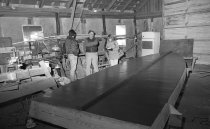
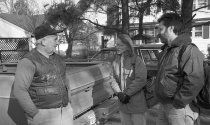
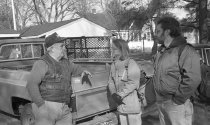
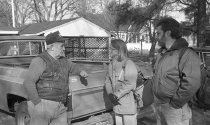
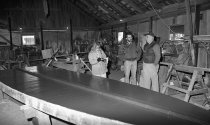
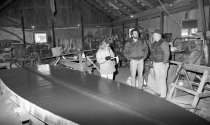
Willard Norris, Grover Lee Owens, Dorothy Norris Interview |
Object Name |
Negative, Film |
Description |
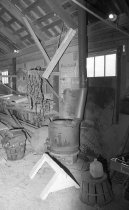
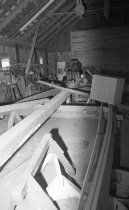
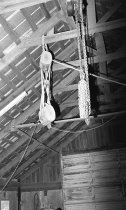
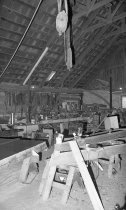
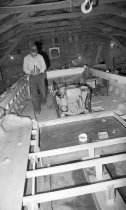
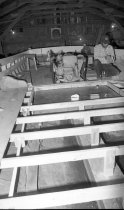
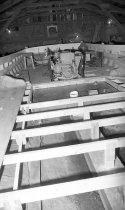
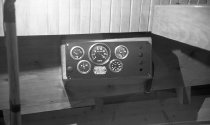
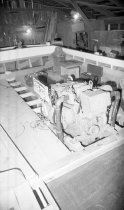
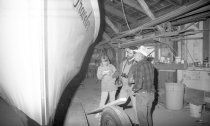
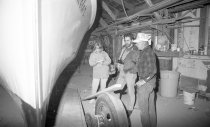
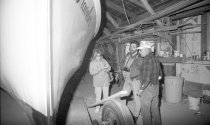
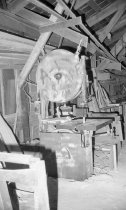
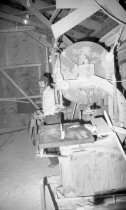
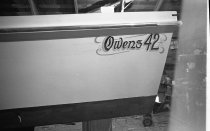
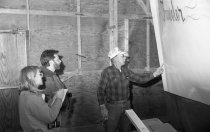
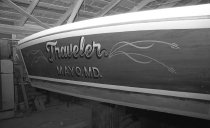
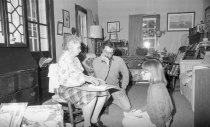
Photos were taken by Larry Chowning for the article "Folklorists Discover Charm of Deltaville's Boatbuilding Heritage," Southside Sentinel, Feb. 6, 1992, pages 2, 7. Deltaville had some curious visitors last Friday member as a member of the Smithsonian Institute and of the Library of Congress in Washington, D.C. came to town to study the area's boat-building heritage.Paula Johnson of the Smithsonian and David Taylor of the Library of Congress talked to longtime boat builder Willard Norris about some of his building techniques. Boats built in Deltaville can be found all over the Chesapeake Bay. This very fact led representatives from the Smithsonian Institute and the Library of Congress in Washington. D. C., to visit Deltaville on Friday and interview several local boatbuilders, residents and watermen. Paula J. Johnson, a maritime history specialist with the Smithsonian, said that she has been surveying work boats in Maryland and has found that a large number of Maryland watermen come to Deltaville to have their boats built. "For a number of years, I've heard watermen all over the Bay talk about Deltaville boats and I just wanted to see where all these boats were coming from.'' she said on Friday. Johnson was editor and contributing writer of Working the Water - The Commercial Fisheries of Maryland's Patuxent River, a book on commercial watermen that was published in 1988 when she was a folklorist at the Calvert Marine Museum in Solomons, Md. She is considered one of the foremost authorities on Bay folklore and she has continued this work while at the Smithsonian. David A. Taylor of the American Folklore Center of the Library of Congress was also along for the tour of Deltaville. Taylor, who is from Maine, was very much interested in the building styles and skills of local boat builders. Taylor's job with the Library of Congress carries him all across the country to work with folklorists and museums in an attempt to preserve local cultures for future generations. In Deltaville, Johnson and Taylor visited skiff builder Willard Norris, deadrise workboat builder Grover Lee Owens, Mrs. Hugh (Dorothy) Norris, whose husband was a boatbuilder for 40 years in Deltaville, longtime waterman Captain Johnny Ward, and Willis Wilson, who runs a railway on Broad Creek. "I have been doing some work on Smith Island [Md.] trying to get a visitors center established and I've talked to several watermen there who own Deltaville boats," said Johnson, a Minnesota native. "I have been hearing about Deltaville boats though since I moved to the Chesapeake area." Deltaville's deadrise work boats have more beam and a hight bow and sides than traditional Maryland-built deadrise work boats. Norris, who has had numerous boats go to Smith Island and other parts of Maryland, explained that Maryland watermen now need bigger boats than they did several years ago. "When Maryland watermen were able to make a living close to home they did not need our (Virginia) style boats, but now that they all fish in the middle of the Bay and are coming all the way down here to pot and dredge for crabs, they need a boat that does well in our type of seas," said Norris. "Maryland boats have lower sides and the bow is not as high as ours so when they get in real choppy seas, the water comes over the sides," he said. Owens had nearly finished a 42-footer in his shop that was going to Mayo, Maryland. He told the two visitors that about half of his boats go to Maryland and the rest go to Tangier Island and other parts of Virginia. The folklorists were also interested in the "ol' timey ways" around Deltaville. Mrs. Norris enlightened them on when her father ran an oyster house in Deltaville in the early 1900s and she even gave them her favorite oyster recipe. "Stew them in their own liquor . . . no milk . . . just butter, salt and pepper," she said. My sister liked them in milk. I didn't," she said. Somebody brought me a pint of oysters for Christmas and they were washed and that took all the taste of them. They had some [oysters] up the store this morning and one woman said they were good. I said, "Woman, you don't know what a good oyster tastes like." "We were raised on oysters," continued Mrs. Norris. "My father used to buy them in October and plant them around his shore. When the creek froze over he would cut a hole in the ice, stand on the ice, and tong the oysters up out the hole and pile 'em up on the ice. "If the steamboat was going he would ship them to Baltimore and, if the oystermen couldn't get out, that's when he would get his big money," she said. "Now you don't know where they are coming from. They have this Urbanna Oyster Festival and most of the oysters come from Calilfornia and the Gulf of Mexico," said Mrs. Norris. Captain Johnny Ward gave them a tour of his buy boat, the Iva W., built on the bank of Jackson Creek in 1929. "I hauled oysters and crabs and I used to run watermelon on her," he said of his boat. He recalled one time when he and his grandsons were out dredging crabs in the Ward Brothers and Nora W. and were off Buoy 36 in the Bay. "It was getting nasty you know and it was just as thick as it could be. John Melvin [Ward] said, Daddy John come on and go. It's time to go. It's getting nastier all the time.' "I said, 'I'm coming along in a minute. I want to fill this barrel up and as soon as I fill it up with hard crabs, I'll come along." " You ain't got no radar and we got radar, why don't you come on with us?' said John Melvin." "I said, "Well if they don't move Jackson Creek and fill the Piankatank up, I can get in there.' "I may have stayed there five more minutes. Then, I opened up on her and put her on a right good run. I passed them, but they didn't see me. I came on in and tied her up to the dock." "I thought, 'That's funny, there ain t no Ward Brothers here. They left here in time to be ahead of me,' " continued Ward. "When they did come, I said, 'That radar didn't help you much.' " "John Melvin said, 'Yeah, when you left there, you put her in the corner,' meaning he had opened up the throttle. " 'Well, I just ran what she's supposed to run,' I told them." The last stop was Willis Wilson's yard on Broad Creek where there were several work boats being repaired. "It's great to see that there is still a strong boat-building heri |
Catalog Number |
2023.60.27 |
Photographer |
Larry Chowning |
Date |
December, 1992 |
Collection |
Larry Chowning Collection |
Source |
Chowning, Larry |
Imagefile |
016\20236027.JPG |