
Archive Record
Images
Metadata
Title |
"'Chunk' stern challenge met; grouper boat nearly finished," George Butler, Reedville Marine Railway, Reedville, VA; Morgan Boats, Naples, FL |
Collection |
National Fisherman Articles by Larry Chowning |
Catalog Number |
2020.9.2.213 |
Date |
JULY, 2001 |
Scope & Content |
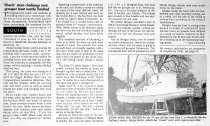
NATIONAL FISHERMAN, JULY, 2001, Pg. 47 AROUND THE YARDS, SOUTH "'Chunk' stern challenge met; grouper boat nearly finished," By Larry Chowning Throughout the south, the tradition of building boats on a creek-bank with the sky as your overhead cover has just about disappeared. Boatbuilders have been exchanging the outdoors for the convenience of avoiding inclement weather for awhile now, and the latest craftsman to give up the wide open spaces is Reedville Marine Railway in Reedville, Va. Owner George Butler will be moving his boatbuilding operation inside a 45' x 35' building that’s currently under construc- tion. A portion of the structure will be for building boats and the rest for storage. Once the structure is completed, the first project will be building a wooden 36-foot deadrise boat. This spring, the paint was drying on a 23’ x 9' skiff for Fred Jet and a 23' x 7‘ skiff for Digger Bradley. Both men are Potomac River pound-net fishermen. They will use the wooden skiffs for carrying nets and their catch as well as setting pound-net poles and hanging nets from the poles. Butler builds only wooden boats, and the stem, sides, bottom and frames of the flat-bottom skiffs are made of spruce pine. Some pressure-treated wood is also used in the boat. Butler fastens his boats together with stainless steel nails unless Monel nails are specified. "If you are going to keep a skiff. Monel nails are the best, but they are expensive," Butler says. Repairing wooden boats is the mainstay of the yard, and Butler is noted for taking on some of the most difficult tasks. He recently put a new bottom and stern on the 53-foot Elva C. The buy boat was built in 1922 by Gilbert White of Foxwells, Va. The vessel has a round stern and an unusual form of "chunk" construction. What Butler found to be different about the stern was the way the short lengths of wood, called chunks, had been fitted together. The standard method of chunking a stern is to build the stern up with short lengths of wood. The chunks that make up each layer are brought together with a butt joint. Each layer is built in the same way, but the seams are positioned so they aren’t over the seams on the lower layer. "It’s like laying cinder blocks," Butler says. The Elva C’s stern doesn't have butt seams. Instead, the blocks of wood are brought together with a rabbet joint. "I’ve worked on a lot of round sterns, but I've never seen this technique used," Butler says. "It makes for a more flowing look to the stern and gives a stronger fit." Butler used 12" x 12" cypress to shape the lower layer of chunks at the chine and 4" x 6" cedar for the next four layers. Where the planking meets the cypress chunks, a rabbet joint was cut by Butler. "It was a lot of work, but at least I didn’t have to do it all by hand the way Mr White did," he says. "He was a master boatbuilder. I'll tell you that." And so it seems is George Butler. Moving on down the coast to the Sun- shine State, Paul Morgan of Morgan Boats in Naples, Fla., has just about completed a 41' x 14' x 3' fiberglass boat. The boat will fish for grouper out of St. Petersburg, Fla., and up to 70 miles offshore in the Gulf of Mexico and Atlantic. The fishing gear consists of four bandits and two elec- tric-powered rod and reels. For power, Morgan installed a pair of 350-hp Cummings Marine C-series diesels, with a dry exhaust system coming out through the roof of the house. On the out- side of the hull are recessed twin keel coolers. Also at Morgan Boats, two 31-footers are under construction. One is for a pleas- ure-boat owner, and the other is going to a commercial grouper fisherman. The commercial boat will be powered by twin 300-hp Yanmar diesels, with semi-tunnel drives for the shafts. Morgan builds his boats with the hull, decking and cabin structure coming out of a mold, but the rest of the vessel is custom built according to the owner’s specifications. Morgan says his firm is seeing some decline in orders of commercial boats because prices for grouper have dropped as a result of imports. However, he says, demand for the 24-foot and 31-foot mod- els is holding up in the recreational boat- ing market. |
Source |
Chowning, Larry |
Imagefile |
009\202092213.JPG |