
Archive Record
Images
Metadata
Title |
"A tradition continues," |
Collection |
National Fisherman Articles by Larry Chowning |
Catalog Number |
2020.9.2.377 |
Date |
SEPTEMBER, 2008 |
Scope & Content |
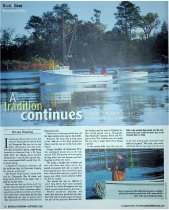
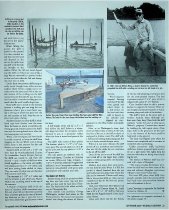
NATIONAL FISHERMAN, SEPTEMBER, 2008, Pgs. 32-33 "A tradition continues," By Larry Chowning If someone tells you they’ve seen bats and tow bats lately, and they’ve been to Chesapeake Bay, you can be just about 100 percent sure they aren’t referring to baseball games, night-flying creatures or characters from a Dr. Seuss book. They are talking about wooden fishing boats — specifically large flat-bot- tom, cross-planked skiffs, usually from 22- to 30-feet long. In Mathews County,Va., watermen call the skiffs tow bats. In Gloucester County, Va., they are simply bats. The French word "bateau" means boat and on Chesapeake Bay all plank and frame-built, deadrise boats larger than a skiff go by that name. Bats and tow bats are frame-built but do not have the deadrise boats’V-shaped bottom sections. Thus, watermen abbre- viated the word bateau to bats or tow bats. The word "tow" comes from the fact that the skiffs lack any type of power other than oars and are towed to and from the fishing grounds. Fishermen in other parts of the bay call the boats simply, seine, trap or dory skiffs. Whatever the name that is used, most of the skiffs are in the bay’s pound-net fishery, and the rest are in the haul-seine fishery. George Snediker of Gravesend, N.Y., first introduced pound nets to the bay around 1875. The pound net is set up by driving stakes into the bottom and then hanging nets from the stakes. The leader, a straight line of poles and nets, runs from near shore out to the pound and guides fish into a couple of heart-shaped bays. The second bay goes into a funnel that leads into a netted-over square area called a head, which is where the fish are caught. The pound net was so efficient it wasn’t long before there were hundreds of pound-net stands throughout the bay, which required small boats to fish them. Modern pound-net fishermen still work their nets very much the way Sne- diker did, and the skiffs remain an impor- tant part of the operation. Waterman Ed- die Gaskins and his sons of Ophelia, Va., have several pound nets in Chesapeake Bay, Maryland’s Potomac River and Vir- ginia rivers. The Gaskins have five skiffs, but use only a single skiff when fishing a pound. In the spring, skiffs carry the nets out to the bare pound poles. Sometimes two skiffs are required. "We need a low, wide- sided boat that we can carry a lot of net in and work from to tie the net to the poles," Gaskins says. When fishing the pound, the skiff is towed to the pound. It is then worked in- side the pound’s head and situated so the net can be pulled into the skiff until the fish are brought to the surface. Either the fish are hand dipped into the skiff, or, if there are a lot of fish, a large dip net operated by a power winder on die tow boat takes the fish and dumps the catch into its hold. Under their own power, skiffs are gen- erally rowed though some older ones are sculled. That’s where a single oar is ex- tended over the stern and with a side-to- side motion of the sculling oar, the skiff moves forward.To hold the oar, the tran- som has either a wooden sculling pin or a notch that the oar’s handle drops into. Most skiffs have a notch in the transom because a sculling pin can snag the net. However, when a pin is used there’s usu- ally a wet rag or towel that goes over the pin and transom to help keep the oar in place and reduce chafing. Another feature on some skiffs is whis- kered rope bow fenders over the stem. Since the boats are towed to and from the fishing grounds, fenders protect the skiff’s stem and the towing boat’s stern when the two bang against one another. When a net is being set, the bow fender is usually removed to keep the skiff from snagging on the net. When a net is being fished, there is less concern for this and fenders on boats are popular. Gaskins’ skiffs are 22' x 8' x 1' 10" and were built by Northumberland County, Va., boatbuilder Francis Haynie. Because the skiffs are towed to and from the pounds — and a couple of skiffs are often towed together — the stems are sturdily built (fashioned from 6" x 8" white oak) and have towing holes drilled in them. They are made of white oak and fastened with stainless steel bolts. The sternpost is 1 1/2" x 4" white oak and the transom is also white oak. Haynie usually cuts a sculling notch in the top of the transom. A feature of Haynie’s skiffs is the ab- sence of a keelson. Skiffs sometimes carry fish, and when fish are shoveled out of the boat, a keelson gets in the way of shovel- ing. Keelsons are also a point for rot to start when freshwater gets between it and the keel. A full-length, white oak 22' x 2" x T keel stiffens the skiff. Below it, a white- oak skeg runs from the sternpost 4-feet forward. It acts as a stationary rudder when the boat is towed and protects the keel. The skiff’s sides consist of three planks. The bottom plank is 1 1/2" x 16" rose- mary pine. The second plank is 1/2" x 8" spruce pine, and the top plank is 1 1/2" x 6" spruce pine. The side planks are stiffened with 15 white-oak frames, 12 inches to 18 inches on center. White-oak bilge stringers, 1 1 /2" x 4" provide additional longitudinal stiffness. In true Chesapeake tradition, the bottom is cross-planked with spruce pine and fastened with stainless steel nails. The oldest net fishery Besides being used for pound-net fish- ing, bats, tow bats, seine, trap and dory skiffs are also used by haul-seine fisher- men. The haul seine is the oldest net fish- ery on Chesapeake Bay. Our nation’s first president, George Washington, worked haul seines on the Potomac River. He owned and operated several nets along the shores of Mount Vernon. Washington targeted herring and shad. The fish were gutted and salted down in a fish house on his land and then the colonies and shipped on con signment to the West Indies, principally Jamaica. Now as in Washingtons time, haul seines are fished close to shore. At the start, one line of the net is tied off on shore or anchored in shallow water. The skiff with a full load of netting starts paying out the net as it heads towards deeper water. When it is out some distance, the skiff is tied off to a powerboat and towed fur- ther out. All the while the net continues to be set off the skiff. Once all the net is out of the skiff the net is tied off to the larger boat, which makes a sweep going down the shoreline with the tide. Modern haul seines have purse pock- ets that hold the fish. When it is full, the pocket is closed, detached from the net and hauled out into deep water where the fish can be removed. If there aren’t many fish in the pocket, skiffs are often used as a platform to dip the fish from the pocket into the skiff. Haul-seine fisherman Allie Walton had Dean Close of Gwynn Island, Va., build him a 25' x 8' x 1' 10" skiff in February 2008 for the Rappahannock River haul- seine fishery. Close used white oak for the frames, fir for the side planking, and spruce pine for the cross-planked bottom. The keel is pressure-treated 4" x 6" pine, which is topped with a pine 4" x 6" keelson. Close installed what he calls a quarter keelson to support the bottom. These are two lengths of pressure-treated 2x4 pine running along each side of the keelson. The skiff is built in the same style as wooden deadrise boats. Although sel- dom seen these days, Close built the skiff outdoors "under the sun," as they say, on Walton’s property. Construction started by building the hull upside down. Close dug a hole in the ground to set the stem in, so the bottom of the boat could be built level to the ground. The boat was flipped over when the bottom was completed and it was time to install the sides and decking. Unlike pound-net skiffs, haul-seine skiffs have battery-powered lights mount- ed on a pipe stand. The lights help the crew see what they are doing when work- ing the net. The bottom of Walton’s skiff was cov- ered with a layer of fiberglass. "The reason we glass the bottom is be- cause the skiff stays on shore most of the time and without a fiberglass coat, worms will get in the wood," Close says. For over 200 years, these skiffs have played a valuable roll in the success of the bay’s haul seine and pound-net fisheries and will continue to do so. |
Source |
Chowning, Larry |
Imagefile |
009\202092377.JPG |