Archive Record
Images
Metadata
Title |
"Aluminum catamaran is sure to turn heads on oyster beds," Lynn Davidson, Davidson Marine, Mathews, VA |
Collection |
National Fisherman Articles by Larry Chowning |
Catalog Number |
2020.9.2.25 |
Date |
October, 1984 |
Scope & Content |
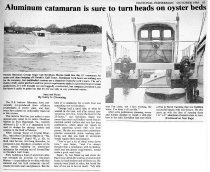
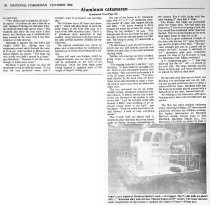
NATIONAL FISHERMAN, OCTOBER, 1984, Pgs. 55-56 "Aluminum catamaran is sure to turn heads on oyster beds" Story and Photos By Larry S. Chowning Florida fisherman George Soper had Davidson Marine build him this 25’ catamaran for oyster and clam dredging off Florida’s Gulf Coast. Aluminum work boats are nothing new for the company, but multihulled versions are a departure from the yard’s norm. The cat’s shallow draft, stable platform and low power requirements make it a practical boat for some applications. It’s well thought out and ruggedly constructed, but company president Lynn Davidson is quick to point out that it’s for use only in very protected waters. The U.S. inshore fishermen have con- sistently out-produced their offshore counterparts in recent years, and their boats have played an undeniably vital role in this success. This inshore fleet has just added a most unusual new vessel to its ranks. Davidson Marine in Port Haywood, Va., recently delivered a 25’ x 10’ x 1* catamaran to be used to dredge for shrimp, oysters and scallops in the Gulf of Mexico. When George Soper of Crystal River, Fla., read about Davidson Marine in "Na- tional Fisherman’’ (April ’83, p. 63), he liked what he saw. Not long thereafter, he contacted Lynn Davidson, president of the firm, about building an aluminum catamaran for working but of Crystal Bay on Florida’s Gulf Coast. Well, building a boat of aluminum alloy was certainly no problem for Davidson Marine — it specializes in working with that material and has built numerous one-off vessels for both work and pleasure. But the idea of a catamaran for a work boat was something new to Davidson. "George had a good idea of what he wanted in the boat, and after several con- versations with him, I drew the lines for the 25-footer," says Davidson. Soper was aware that most multihulled vessels feature minimal wetted surface and very low drag coefficients, which allow the vessels to reach surprising speeds with very little power. He also was aware that catamarans provide reasonably stable working plat- forms and that one built of aluminum would require little maintenance. "You’ve got a lot of shoal water down here," says Soper, "and I’ve always thought that a catamaran, with its shallow draft and low power requirements, would make a good work boat." Soper, 78, has fished up and down the East Coast all his life and has owned several boats for both inshore and offshore use. He recently went South to retire, but found the lure of the sea to be too much. "My wife says I’m crazy, but I love working the water. I’ve done it all my life." After some preliminary planning, owner and builder decided to install a sled-type bow in the hulls. Davidson had read about a firm in North Carolina that was building successful barges with this feature. He also came up with the idea of running three 1-1/2" x 3" aluminum channels stem to stern on each hull. "This stiffens and strengthens the hull,’’ he reports. "It softens the ride a little bit as well. Instead of having just flat plate there, the channels help break up the water." The channels also make the boat track a little better, but Davidson says a catamaran sits deep enough in the water that it has little tendency to slide anyway. Although it appears big and bulky and weighs 5,000 lbs., during tests the catamaran cruised easily through the water at 25 m.p.h. with two 80-h.p. Mercury out- board engines for power. "The boat was very steady and didn’t pound in a chop," says Davidson. "Because of the flat bows, though, it made some noise." Davidson is quick to point out that the catamaran is not an offshore vessel. "It is a boat for very protected water, and I wouldn’t, want to pretend it was anything else." The 25-footer has a 10’ beam and draws only 1', which will allow Soper to work the shoal waters of the Gulf with ease. It is made from 5086 aluminum plate. The 6’ x 6’ pilothouse gives protection in foul weather. Large windows in the front and on the sides provide excellent visibility for the helmsman. The slanted windshield cuts down on glare, and a small porthole fo ventilation is located just in front of the helmsman’s station. Soper will work two dredges, which he designed himself, and two electric winches will be positioned on the roof of the pilothouse, which has been made extra strong because it supports most of the weight of Soper’s fishing gear. The top of the house is 1/8" aluminum plate with 14" x 4" x 4" aluminum chan- nels spaced 18" apart that support the top and sides. "The heavy framing is there because the house has to take the strain of lifting the big dredges," he says. "The channel goes all the way from the deck, up one side, across the top and down the other side. The house is strong. It’s almost like a gantry frame." The pilothouse is open aft and is conserv- atively laid out with throttle controls and shifters on each side of the center-mounted steering wheel. Teleflex twin steering has been installed, giving Soper a separate cable to each motor. "The steering behavior is perfect," says Davidson. "It does whatever you-want it to do. There is even reasonable steering with one engine. That surprised me because it is so far off center, but it works." Two man- sized hatches in the work deck aft allow 39" centers. The 4’-wide bridge deck has solid framing 9" deep and 4’ wide. Two 40-gal. fuel tanks are positioned under the bridge deck. The fuel tanks are situated so if they were to spring a leak, the fuel would flow overboard rather than into the hull. The two access hatches in the work deck allow Soper to clean his tanks. The hull is given additional strength in the sides with the two 1-1/2" pipes Davidson has run the length of the boat. "This pro- vides strength and acts as a guard rail to protect the hull," he says. A rail made of 1-1/4" aluminum pipe goes completely around the sides of the 25-footer to keep the fisherman from falling overboard. A 5’ disappearing gate — 1" pipe that slides up into the 1-1/4 " rail — is placed on the port side. The large opening permits Soper to bring gear and boxes aboard and to unload his catch at deck level. On the work deck there are six cleats: two Soper access into the hulls to repair a steer- ing cable or correct any other problems that might arise. The two outboards are set on excep- tionally strong, reinforced aluminum tran- som mounts. A plastic battery box is posi- tioned just forward of the engines in each motor well. "I put the batteries in the wells because I didn’t want anything of an ex- plosive nature down in the hull," says Davidson. "Then we would have had to in- stall blowers. I tried to keep everything simple." The 3’-wide hulls are plated with an aluminum alloy and each has seven frames made of flatbar running athwartships on forward, two amidships and two aft. Lift- ing eyes are also positioned there to allow a crane to lift the vessel. Davidson adds that the boat can be easily moved around with a fork lift from the sides, forward and aft. All welding in the boat meets ABS speci- fications and is done with the MIG inert gas system. The firm has other projects underway and is currently building a 58’ three-masted aluminum schooner for offshore cruising. For further information on Davidson Marine’s vessels, contact Lynn or Don Davidson, Davidson Marine Inc., Port Haywood, VA 23138, tel. (804) 725-2059. |
Source |
Chowning, Larry |
Imagefile |
008\20209225.JPG |