Archive Record
Images
Metadata
Title |
"45-footer gets major repairs; museums are aiding watermen," Cockrell's Marine Railway, Heathsville, VA; Mathews Maritime Foundation, Mathews, VA; Pulley's Marine, Gwynn's Island, VA |
Collection |
National Fisherman Articles by Larry Chowning |
Catalog Number |
2020.9.2.423 |
Date |
OCTOBER, 2010 |
Scope & Content |
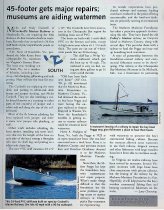
NATIONAL FISHERMAN, OCTOBER, 2010, Pg. 38 AROUND THE YARDS, SOUTH "45-footer gets major repairs; museums are aiding watermen," By Larry Chowning Myles and Andy Cockrell of Cockrell’s Marine Railway in Heathsville, Va., are repairing the Miss Karen, a 45-foot wooden deadnse work- boat. Recently they completed a 24-foot skiff built of polyvinylchloride panels on speculation. T.O. Nutt of Reedville, Va., pur- chased the Miss Karen from a Mappsville, Va., waterman on Virginia’s Eastern Shore. The boat was working out of Saxis, Va.. in a number of fisheries, including clam- ming, crab dredging, gillnetting and crab potting. Nutt will use the boat for oys- tering. The Cockrells are replacing the stern deck, and putting in white-oak deck beams and juniper decking, says Myles Cockrell. They are also installing a col- lar board (known as a coaming in other parts of the country) of juniper and a white-oak rail along the top of the col- lar board. Most of the fir bottom planking has been replaced with juniper, and there j is some new juniper side planking, as i well. Other work includes rebolting the horn timber, installing oak sister keel- sons that run the length of the boat on each side of the keel, setting a fiberglass cube into the shaft log, and putting in a white-oak chine log. The new PVC skiff measures 24' x 9’ x 12". The Cockrells have been innova- tors in the Chesapeake Bay region for building boats out of PVC. The boats are built with 1 -inch-thick PVC on the bottom and sides, except in high-stress areas where it’s 1 1 /4-inch thick. The parts are cut out of 4-foot- wide panels that are 20 feet long. The skiff has a 90-hp Ya- maha outboard, which gets the boat up to 40 mph. The outboard is easy on fuel, us- ing just three gallons to go 16 miles at full throttle. ’’Old buy boat finds new home" (NF Oct. ’08, p. 42) mentioned that the Mathews Mari- time Foundation in Mathews County, Va., had obtained the wood- en buy boat Peggy and were having the en- gine replaced at Ampro Shipyard in Weems, Va. Now the foundation’s troubles in getting ac- cess to marine railways could be a boon to local watermen. Harr)' A. Hudgins of Peary, Va., built the Peggy in 1925 as an open pound-net boat. She was later converted into a deck boat. Peary is in Mathews County, and previous owners Kim and Gretchen Granberry donated it to the Mathews Maritime Founda- tion. Since then, the 55- foot Peggy has kept the foundation busy with maintenance $ and repair projects. J What’s made things difficult is that the foundation has the same problem gain- ing access to marine railways as Chesa- peake Bay watermen are experiencing. As outside corporations have pur- chased railways and marinas, hauling costs have escalated to the point of being unreasonable, and the haul-out facili- ties are primarily catering to recreational boats. The Mathews Maritime Foundation has taken a proactive approach to stem- ming this tide. They have leased the old Pulley’s Marine railway on Gwynn’s Island in Mathews County, along with several slips. This provides them with a railway to haul the Peggy and may end up benefiting local watermen. A type of partnership between the foundation-owned railway and com- mercial fishermen seems to be devel- oping. The railway at the Chesapeake Bay Maritime Museum in St. Michaels, Md., was a forerunner in partnering with watermen to preserve the bay’s commercial fishing culture. Because the museum allowed some watermen to use their railway, skipjack owners and other fishermen with large wooden boats have been able to continue work- ing. In Virginia, no marine railways have been owned by museums. Several Vir- ginia museums with large boats have close associations with private railways, but the leasing of the railway by the Mathews Maritime Foundation is a first. Hopefully, it will help preserve the bay’s wooden conunercial fishing fleet and keeping commercial fishermen on the water. |
Source |
Chowning, Larry |
Imagefile |
010\202092423.JPG |