
Archive Record
Images
Metadata
Title |
"50-footer sports new frames; crabber opts for glass, wood," Deagle's Boatyard, Deltaville, VA; Carman Boats, Marion, MD |
Collection |
National Fisherman Articles by Larry Chowning |
Catalog Number |
2020.9.2.237 |
Date |
JULY, 2002 |
Scope & Content |
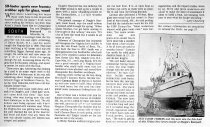
NATIONAL FISHERMAN, JULY, 2002, Pg. 47 AROUND THE YARDS, SOUTH "50-footer sports new frames; crabber opts for glass, wood," By Larry Chowning When Glenn Armstrong has major repair work done to his 45-year-old wooden trawler, he doesn’t think twice about making the 36-hour run from New Jersey's Sandy Hook Bay to Chesapeake Bay and Deagle’s Boatyard in Deltaville, Va. That’s where Armstrong’s boat the Vir- ginia-Sue was this past April. Armstrong, of Union Beach, N.J., and his uncle bought the Virginia-Sue in 1980. They had been working a 40-footer and wanted something bigger. Several years ago, he bought his uncle out and now owns the 50’ x 16’ x 7’ boat. From the spring through the fall, Armstrong fishes the Vir- ginia-Sue for flounder, whiting, and squid; in winter, he crabs with the boat. Three years ago, Armstrong was looking for a yard to do major repair work to the Virginia-Sue. A lobsterman in his area told Armstrong about Deagle’s boatyard after Edward Diggs of Mathews County, Va., not far from Deltaville, built him a 50-foot wooden lobster boat. "I needed some major work done, and I took it to Deagle’s, and I liked their work, so I came back this time," says Arm- strong, who was having new ribs and floor timbers put in the fish hold. The old timbers were being replaced with 4-by-4 fir and fastened with stainless steel. While the Virginia-Sue was getting new framing, the yard checked the rest of the boat for bad wood and didn't find any. Since the boat was already hauled, her bottom was scraped and painted. Deagle’s Boatyard has two railways, but the larger railway is tied up for a couple of years with a major rebuilding project on the Commodore, a 111-foot wooden Trumpy yacht. The general manager of Deagle’s Boat- yard, Janie Ruark, says the small railway is booked solid through the spring. "When Glenn finishes, I’ve got boats waiting in line to get on that railway," she says. "It’s nice to have the work but it seems to all come at once." Followers of Chesapeake Bay boatyards will recognize the Virginia Sue’s builder. It was the late Frank Smith of Bena, Va., who built the boat in 1957. Smith was a third-generation bay boatbuilder who built quite a few wooden trawlers for fishermen from Ocean City, Md., Atlantic City, N.J., Cape May, N.J., and Long Island, N.Y. He was a good example of a Virginia boat- builder who could build more than just traditional cross-planked and staved-bow Chesapeake Bay deadrise workboats. Moving a little further up the bay, along Maryland’s Eastern Shore, Ronnie Car- man’s Carman Boats of Marion is backed- up with new boats to build. Most of them are head boats, but the yard has com- pleted some commercial fishing boats this year. One of those was a 32-foot crab boat for Ronnie’s brother James Carman of Crisfield, Md. Jay, as he is called by those who know him well, uses his 32’ x 9’ 7" x 2’ hand-laid fiberglass Chesapeake Bay deadrise boat for crab potting on the ocean side of Mary- land’s Eastern Shore in early spring, and on Pocomoke and Tangier sounds on the bay side the rest of the season. A 250-hp Yamaha outboard engine pow- ers the new boat. It is an open boat so Carman can carry as many pots as possi- ble to and from the fishing grounds. Carman also delivered a 40-foot, fiber- glass-over-wood boat last month to Dean Steel of Kent Island, Md., for crab potting. Steel did the installation work for his 320- hp 3208 Caterpillar. "Most watermen request solid glass boats now," says Car- man, "but some water- men say our glass-over-wood boats work more like a wooden boat down a line of pots. A lot of them are used to wooden boats." Carman has molds for solid glass deadrise boats in 27-, 32- and 46-foot lengths. "We still build several commercial fishing boats a year, but that might change with the new reg- ulations," he says. Car- man builds mostly commercial crab boats, but he fears that new reg- ulations may slow that work down. Maryland has just passed laws to change size limits on hard crabs and peelers, says Carman. The new laws require hard crabs to be 5 1/4-inches long and peel- ers 3 1/2-inches long. Pre- viously, regulations called for 5-inch hard crabs and 3-inch peelers. Carman says, "The state is getting hard on everyone with regulations, and the impact trickles down to us. More and more watermen are afraid to make the kind of investment it takes to build a boat, not knowing from year to year what the future will bring." |
Source |
Chowning, Larry |
Imagefile |
009\202092237.JPG |