
Archive Record
Images
Metadata
Title |
"60-footer readied for fall; skiffs meeting fleet's needs," Jennings Boatyard, Fairport, VA; Carolina Skiff, Waycross, GA |
Collection |
National Fisherman Articles by Larry Chowning |
Catalog Number |
2020.9.2.310 |
Date |
OCTOBER, 2005 |
Scope & Content |
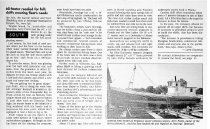
NATIONAL FISHERMAN, OCTOBER, 2005, Pgs. 43 AROUND THE YARDS, SOUTH "60-footer readied for fall; skiffs meeting fleet's needs," By Larry Chowning In July, the marine railway and boat- building shop at Jennings’ Boatyard in Fairport, Va., were full. Tangier Island, Va., boatbuilder and fisherman Jerry Pruitt had the 60’ x 18’ Delvin K. on the rails getting ready for the fall oyster planting season. Last season, his first load of seed oys- ters about put the boat on the bottom when water rushed through the Delvin K's plank seams. "She had been laid up at the dock so long her side seams opened up on her," says Pruitt on a 100-plus- degree day. To cover the seams, Pruitt was glassing over the hull with polyester mat and resin, from the gunwales to about 22- inches from the keel. Last year, he replaced 30 worn out bottom planks with 2 3/8-inch-thick planks and added a new guard and some new decking. "We are getting her in great shape," says Pruitt, who is doing the work him- self. Jennings’ Boatyard is located on the western shore of the Chesapeake Bay, so Pruitt arrives by boat on Monday from Tangier Island and lives aboard the Delvin K. until after work on Thursday. That night, he motors home to the island for a long weekend with his family and to supervise his own yard, which isn't equipped to haul a boat as big as his. Pruitt hopes to use the Delvin K. to plant seed oysters in Virginia's oyster replenishment program. Although no date has been set for starting the program, state funds have been set aside. Meanwhile, Jennings has a 42' x 14' sportfisherman under construction for Jim Loop of Springfield, Va. The boat will be powered by two 370-hp Yanmar diesels. The boatyard’s owner, Larry Jennings, says he builds a boat a year and the rail- way stays busy, but his "cash cow" is his travel lift and onshore boat storage for do- it-yourself fixer uppers — both recreation and commercial. Several owners of wooden commercial fishing boats were working on their boats in July. He always makes sure there is dock space for commercial fishing boats. One of the boats tied to the dock was a Jerry Pruitt-built 42-foot wooden deadrise, loaded down with crab pots. Further south in Waycross, Ga., Car- olina Skiff is filling a growing small- boat demand for inshore commercial fishermen. Last year, the company delivered just shy of 6,000 skiffs between 12 feet and 27 feet. Most were sold on the East Coast, and about 600 went to commercial fisher- men from Maine to Florida, says Robert Sass, Carolina Skiff's advertising and mer- chandising director. Most commercial fishermen are buying 17 to 24-foot models. "They need a boat that can carry a lot of weight and is roomy," Sass says. Many of the boats go to the shrimp fishery around Key West, Fla., where throw-nets and dragnets are used. North Carolina and Virginia blue-crab fishermen are buying the boats to catch soft-sheii and peeler crabs. About 15 years ago, blue-crab fisher- men in North Carolina and Virginia started following the early spring runs of peeler and soft crabs from river to river. The runs start earlier further south and fishermen needed a small boat that could be trailered from one crab run to the next. Sass says they are selling boats to uni- versity-sponsored research programs in Florida and the West Indies. Six 16' x 4' 2" vessels went to a University of Miami shark research program in the Bahamas. Researchers are using the skiffs to catch, tag and release bull and tiger sharks with trotlines. The 16-footers are powered by 10-hp to 40-hp outboards. An Ohio University research program bought several 27' x 8' 7" boats powered by twin 90-hp Yamaha outboards for underwater survey work in Florida. Carolina Skiff offers commercial fisher- men a 5 percent discount on any of their boats. All a fisherman has to do to get the discount is show his license. In the past, the company offered 10 percent off its larger skiffs, but because of increases in petroleum products used to build the skiffs, that has been dis- continued. "The increase in petroleum is hitting fiberglass boatbuilders, commercial fish- ermen and everyone else in the pocket- book," Sass says. Amen to that. |
Source |
Chowning, Larry |
Imagefile |
009\202092310.JPG |