Archive Record
Images
Metadata
Title |
"1984 Winter Dredge Season for Virginia Crabbers" |
Collection |
National Fisherman Articles by Larry Chowning |
Catalog Number |
2020.9.2.41 |
Date |
December, 1985 |
Scope & Content |
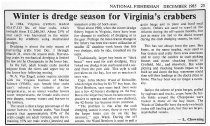
NATIONAL FISHERMAN, DECEMBER, 1985, Pg. 23 "1984 Winter Dredge Season for Virginia Crabbers" By Larry Chowning Winter is dredge season for Virginia'a crabbers In 1984, Virginia crabbers landed 50,417,513 lbs. of blue crabs, which brought them $12,240,345. About 25% of that catch was harvested in the winter season by crabbers using mechanical dredges. Dredging is about the only means of harvesting crabs from Dec. 1 through March 31, when the season ends. Harvest- ing crabs by mechanical dredging is limited by law on the Chesapeake to the lower bay. In the fall, adult female crabs (sooks) migrate from the rivers and upper bay to the lower bay following mating. W.A. Van Engel, senior marine scientist with the Virginia Institute of Marine Science (VIMS), says female blue crabs can’t tolerate low salinity at low temperatures, so as winter weather lowers water temperatures, the female crabs move into deeper, warmer waters and burrow in the bottom. The result is that a large percentage of the winter harvest is female crabs. Van Engel reports that approximately 85% of the crabs caught arc adult females, and the re- maining 15% are male crabs (jimmies) and immature crabs of both sexes. Since about 1900, when the winter dredge fishery began in Virginia, there have been few changes in methods of dredging or in the gear. Perhaps the most drastic change in the fishery has been the recent utilization of smaller 42’ deadrise work boats that fish two dredges, side by side, mounted on the stern. Traditionally, larger buy boats or "deck boats" were used for crab dredging. They fished one dredge from starboard and a sec- ond from the port side. This style is still prevalent on the bay, but not as much as it once was. Capt. John Melvin Ward of Deltaville, who dredges the bay in his 75’ buy boar, the Ward Brothers, says years back there were just a few 42-footers dredging on the bay. But as the larger buy boats became more ex- pensive to operate and other uses declined, the 42-footer has become more common. "The problem is that after the crab dredging season is over, there is very little the larger boats can do on the bay anymore," says Ward. During the off season, the Ward Brothers is used to pull a grain barge and to plant and haul seed oysters. Others are used to trawl in the Atlantic during the off-season months, but just as many are tied to the docks except during the crab dredging season, he says. This has not always been the case. Buy boats, as the name implies, were used to buy oysters and crabs from area watermen and to carry the catches to crab picking houses and oyster shucking houses in Crisfield, Md., and elsewhere. But when picking and shucking houses began to be built up and down the bay, watermen could then sell their landings at the docks close to home. The buy boat was no longer a necessity. Before the advent of grain barges, pulled by tugboats and trucks, crops from the fer- tile fields around the Chesapeake were hauled in many of the buy boats. The Wards of Deltaville have the only two boats today still hauling grain, but they are larger, steel-hulled vessels. |
Source |
Chowning, Larry |
Imagefile |
008\20209241.JPG |