Archive Record
Images
Metadata
Title |
"A pioneer in marketing live eels," George Robberecht, Mt. Holly, VA |
Collection |
National Fisherman Articles by Larry Chowning |
Catalog Number |
2020.9.2.88 |
Date |
OCTOBER, 1988 |
Scope & Content |
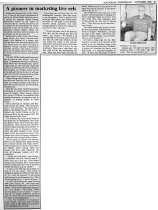
NATONAL FISHERMAN, OCTOBER, 1988, Pg. 31 "A pioneer in marketing live eels" By Larry Chowning Robberecht Seafood Inc. of Mt. Holly, Va., is one of the largest distributors of eels in the United States, exporting nearly 2 million lbs. annually. Before George Robberecht moved to the shores of Nomini Creek on the Potomac River, the eel market on the Chesapeake was mostly confined to the sale of salted eels to the Maryland trotline fishery. When the Dutchman moved in with his family, the eel fishery on the bay took off. Robberecht’s story is not one of over- night success. It is a story of a man and a family who believed in a dream, and through hard work and determination saw that dream come true. Born and raised in Holland, George married a fisherman’s daughter, Hermina. Her earliest recollec- tions are of eeling with her father along the ditches near her home in Den Helder, Holland. "He [my father] made small hoop nets and set them in early spring," says Her- mina. "I remember one time, we went to a ditch where the cows drank from, and he caught a big eel. We only had a milk pail to put it in, and this one eel was so big, it kept jumping out. Finally, he put the eel in the pail and told me to sit on it with my skirt over the pail to keep the eel in, while he went home to get a burlap bag." When George and Hermina were first married, they fished for eels on Ijsselmeer Lake in a hotter (sailing craft made of oak) with a trawl-type net, but World War II ended that. After the war, there was little prosperity in Holland, so the Robberechts decided to move to Canada. There, George worked in a variety of different occupations from running a restaurant, to carpentry work in Ontario, to hauling lumber in Nova Scotia. But in the back of George’s and Her- mina’s minds was eeling. "We missed the water," says Hermina. "We always had a mind to go fishing for eel. We went to Quebec and started fishing on the St. Lawrence River for eels around 1953. We fished day and night there." The Robberechts found small markets for salted eels in Philadelphia, New York and Boston where there were large Italian populations. After several years, the Rob- berechts began exploring the possibility of selling their eels to European markets. There was little demand in the United States, and it was seasonal as most of the Italians and other European immigrants bought eels only during holiday seasons. The eel season in Canada was relatively short so the Robberechts began looking for a warmer climate and longer season. This led them first to the St. John’s River in Florida, where George eeled and bought eels from other fishermen. By now, his European markets were well- established. "Things were still hard," says George. "I remember one time, I had no money. I didn’t have $5 to buy gas. I had money coming from Europe, but I never knew when it would come. So I went to the local sheriff and had to ask for money." It wasn’t until 1963 that things began to look up for the family. They rented a building at McGuire’s Wharf in Mt. Hol- ly, Va., with the purpose of harvesting and buying eels on Chesapeake Bay. They started paying 8c/lb. to local watermen. In 1965, the Robberechts began fishing near Cape Charles, Va., with hoop nets that Hermina had learned to use from her father. "They [local watermen] laughed at us," says George. "They asked, ‘What are you going to catch in those — birds?’ One day we caught 10,000 lbs. of eel in one net. There were eels everywhere when we came to the Chesapeake." Later, they established an eel plant in Cape Charles, which they still own along with a plant in Mt. Holly and a process- ing/packaging plant in Italy. Everything has not been rosy for the Robberechts, however, since their move to the Chesapeake. They’ve had two fires at the Mt. Holly plant, one of which burn- ed much of the plant to the ground. Another dismal experience was when George decided to buy his own airplane to haul his live eels to Europe. "We got the plane, and it did good the first trip, but the second trip was bad news," says George. "We loaded it up with $80,000 worth of eels, and it took off just fine. But 100 miles offshore, it lost one engine and began to lose altitude. They [the crew] turned around and head- ed back, but they had to throw my eels overboard. There was a ship there, and here were all my eels bombarding this ship. What was even worse was that we had $1 million worth of insurance on the plane but not the contents. It was an ex- pensive day for us." The Robberechts were soon out of the airplane business and back to shipping live eels on passenger flights out of New York City. Even now, they sometimes have trouble getting all their eels to Europe alive. "They don’t pay us for dead eels," says George. The whole Robberecht family is involv- ed with the business. Maurice Bosse, hus- band of daughter Wilhelmina, manages the plant at Mt. Holly; John Oord, hus- band of daughter Sophia, is an eel fisher- man as is son George Jr. It’s been a long road for the Rob- berechts, but their trip to the New World ended up as an American dream come true. But Hermina still thinks of Holland. A picture of a thatched-roof house, once their home, is a treasured keepsake of hers. "It was a nice big house we had in George Robberecht Holland," she says. George says, "It wasn’t as big as your kitchen is here." "Yes, eels," says Her- mina, "they’ve been good to us." |
Source |
Chowning, Larry |
Imagefile |
008\20209288.JPG |