Archive Record
Images
Metadata
Title |
"1977-built boat is redone for oystering; Fat Spat survives sinking and hogging," Kellum Brothers, Weems, Va.; Cowart Seafood, Lottsburg, Va. |
Collection |
National Fisherman Articles by Larry Chowning |
Catalog Number |
2020.9.2.510 |
Date |
NOVEMBER, 2013 |
Scope & Content |
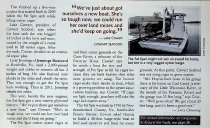
NATIONAL FISHERMAN, NOVEMBER, 2013, Pgs. 38-39 AROUND THE YARDS, SOUTH "1977-built boat is redone for oystering; Fat Spat survives sinking and hogging," By Larry Chowning Virginia Gov. Bob McDonnell an- nounced in August that preliminary figures for the state’s 2012-13 oyster har- vest show commercial oystermen catch- ing 320,000 bushels with a dockside val- ue of SI 1.2 million. That’s a substantial increase over the 20,000 bushels landed a decade ago. It takes boats to work Virginia’s oyster fishery, and when the industry expands, so does the demand for boats to plant, grow and harvest oysters. Two Virginia oyster companies, Kellum Brothers in Weems and Cowart Seafood in Lotts- burg, are upgrading their fleets to keep up with the growth. Kellum Brothers President Jeff Kel- lum. his brother Tommy, uncle Joe and cousin Brandon Kellum recently bought and rebuilt a used 42-foot Hulls Un- limited East fiberglass workboat built in 1977. Hulls Unlimited East in Deltaville, Va., built fiberglass deadrise workboats from 1972 un- til the late 1990s when the boatshop closed. The High Hopes, named afterjeff and Tommy’s moth- er, was hauled at Ampro Shipyard in Weems. The yard fabricated a hydraulic oyster dredge winder, mast and a boom. Portions of the cabin and the washboards were replaced. A new engine box was built, and the sides and bottom were gel coated and painted. Wave Rid- er Manufacturing of Topping, Va., did the fiberglass work. "Hulls Unlimited East built a heavy boat, one that’s just right for oystering," saysjeff. "We bought the boat from Ry- land Gaskins a longtime waterman who had it built in 1977. Ryland was the only owner, and we knew he took care of it." Tommy says, "Virginia’s oyster in- dustry is growing, and we think there is a bright future here for us. We are so convinced of that that we’ve expanded our operations, and part of the expan- sion was the purchase and repair of the High Hopes to help acconunodate that growth." In April, Cowart Seafood of Lottsburg had Ampro Shipyard remove a pair of 8.2-liter Detroit Diesels from the 33' x 13' 6" Fat Spat, a fiberglass-over wood barge, and replaced them with a pair of new 210-hp Cummins 6BTA engines. That finished up a five-year project that started back in 2009 when the Fat Spat sank while lifting oyster cages. Lake Cowart, president of Cowart Seafood, says when the boat sank she was hogged 14 inches at the bow and stern, caused by the weight of a crane used to lift oyster cages. After she sank, Cowart decided on an extend- ed repair plan. Larry Jennings ofjennings Boatyard in Reedville, Va., used a 2,000-pound weight and cables to remove all but 2 inches of hog. Fie also fastened new planks in the sides and rebuilt the stern. That was enough to get the Fat Spat back working. Then in 2011, Jennings rebuilt the cabin. This year, besides the new engines, the Fat Spat got a new marine plywood bottom. "We’ve just about got ourselves a new boat," says Cowart. "She’s so tough now, we could run her over land mines and she’d keep on going." The Fat Spat carries oyster cages to and from oyster grounds on the Coan River, a tributary of the Potomac River. Cowart says he needs a boat the size and strength of Fat Spat to lift his cages be- cause they are built heavier than what most growers are using. The heavier cages make them harder to steal, which is a growing problem in the oyster aqua- culture business, says Cowart. "If cages are light enough, poachers will take the cage and oysters away." The Fat Spat was built in 1976 by Nor- thumberland County, Va., boatbuilder Francis Haynie. Cowart asked Haynie to build a 38-foot barge-style boat to haul seed oyster to and from his oyster Spat might not win an award for looks, is a very rugged oyster barge. grounds. At that point, Cowart Seafood was not using cages to grow oysters. "Mr. Haynie built boats in his garage there at his house on Cod Creek [a trib- utary of the Little Wicomico River, at the mouth of the Potomac River] and the garage was 33 feet long," says Cow- art. "Well guess what? We got a boat 33 feet long, and it’s been a good one." |
Source |
Chowning, Larry |
Imagefile |
011\202092510.JPG |