Archive Record
Images
Metadata
Title |
"1842 railway still operating; Va. boatman busy since '30s," Tim Smith, Smith Marine Railway, Dare, VA; Alvin Sibley, Deltaville, VA |
Collection |
National Fisherman Articles by Larry Chowning |
Catalog Number |
2020.9.2.244 |
Date |
NOVEMBER, 2002 |
Scope & Content |
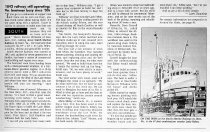
NATIONAL FISHERMAN, NOVEMBER, 2002, Pg. 49 AROUND THE YARDS, SOUTH "1842 railway still operating; Va. boatman busy since '30s," By Larry Chowning "Tf you go to a restaurant at supper time land there are no cars out front, you best think twice about eating there. It’s the same thing with a railway. I have to call far in advance to make sure they can work me in because they are so busy and so good." That’s Forrest Williams of New Bern, N.C., talking about Smith Marine Railway in Dare, Va., the boatyard that maintains his 87’ x 20’ x 10’ Lady Helen, a scallop, shrimp and groundfish trawler. Smith Marine Railway was started in 1842 and, guided by seven generations of Smiths, has been a center of commercial boatbuilding and repairs ever since. The boatyard went from hauling boats with a horse-powered windlass, to a Fair- banks-Morse gasoline engine, to a 10-hp electric motor with a 300:1 reduction that's still used today. "It's so smooth that you can sit on the deck of the Lady Helen and when they start the railway, you can hardly tell you are moving," says Williams. . Williams is one of several fishermen in the New Bern, N.C., area that uses the railway. "It’s hard to find a good wood- working yard today," he says. And Williams does appreciate good woodwork-, ing skills. After all, in 1978, he hired the late Royce Spain to build the Lady Helen. Williams also bought cypress and heart pine for the boat and air-dried it for two years. Then Spain, Earl Hopkins and Williams built the Lady Helen. "I can tell you exactly how many nails are in that boat," Williams says. "I got a master boat carpenter to build her and I take her to the best railway to keep her fixed up." Williams’ son Paul runs the Lady Helen. The boat has a 120-day scallop permit for the Atlantic scallop fishery, and this year chased shrimp off South Carolina as well as trawled for flats in the ocean-flounder fishery. Tim Smith, the boatyard’s foreman, says that the Lady Helen received new rubrails made-up of oak covered with stainless steel to keep the nets from chaffing through the wood. She also had a fair amount of work done below the waterline. That included bottom painting, cleaning and sanding the prop, and replacing zincs and the keel cooler. Once that was done, the sides were painted. "We used to build boats here but it keeps the railway tied up too long," Smith says. "So, we went strictly to main- tenance, and we have plenty of work," Smith says. The yard works with wood, steel and fiberglass but wood is its specialty. "We do some steel here, but we have to sub- contract a lot of that work out. We can work in fiberglass but none of us like it. Wood is what got us here and has kept us here and our reputation centers around woodworking," Smith says. Alvin Sibley of Saluda, Va., is rebuild- ing a boat that has been used in the patent-tongue clam fishery. Sibley has been building and repairing deadrise workboats since the late 1930s. He learned the boatbuilding trade from his father-in-law, Johnny "Crab" Weston, and has built nearly 100 boats. Sibley was forced to close his boatbuild- ing shop in Deltaville 10 or so years ago, due to a bout with cancer. But his skills are still in demand by commercial fisher- men, and so he now works out of the back of his pickup, repairing and rebuild- ing about 20 boats a year. Recently, Dave Cottrell of Urbanna, Va., asked Sibley to rebuild the 45- foot, 1965-vintage, dead- rise clammer Jeane S. The workboat was used in the patent-tong clam fishery by watermen Andrew Sim- mons of Kilmarnock, Va., and built by Smiley Jenk- ins of Perrin, Va. Cottrell bought the boat with the understanding that Sibley would rebuild her. "I could build an entire new boat quicker than I can fix this one," Sibley says. The boat is under a large tent at Southside Marina in Urbanna with the house and decks pulled off. Sibley started by replac- ing bottom planking with local pine. He'll rebuild the classic round chuck stern and replace the horn tim- ber with west coast fir. After that, the boat gets a new deck and pilothouse. "It’s nice that people are beginning to appreciate wooden boats and the work that I do," Sibley says, "but I’m just thankful I can keep working." And so are a lot of other people. |
Source |
Chowning, Larry |
Imagefile |
009\202092244.JPG |